
This work was inspired in Adinkra aphorisms and written as a result of an artist residency program at the Library of Africa and of the African Diaspora, in Accra, Ghana. Between February-March, 2024.
* * *
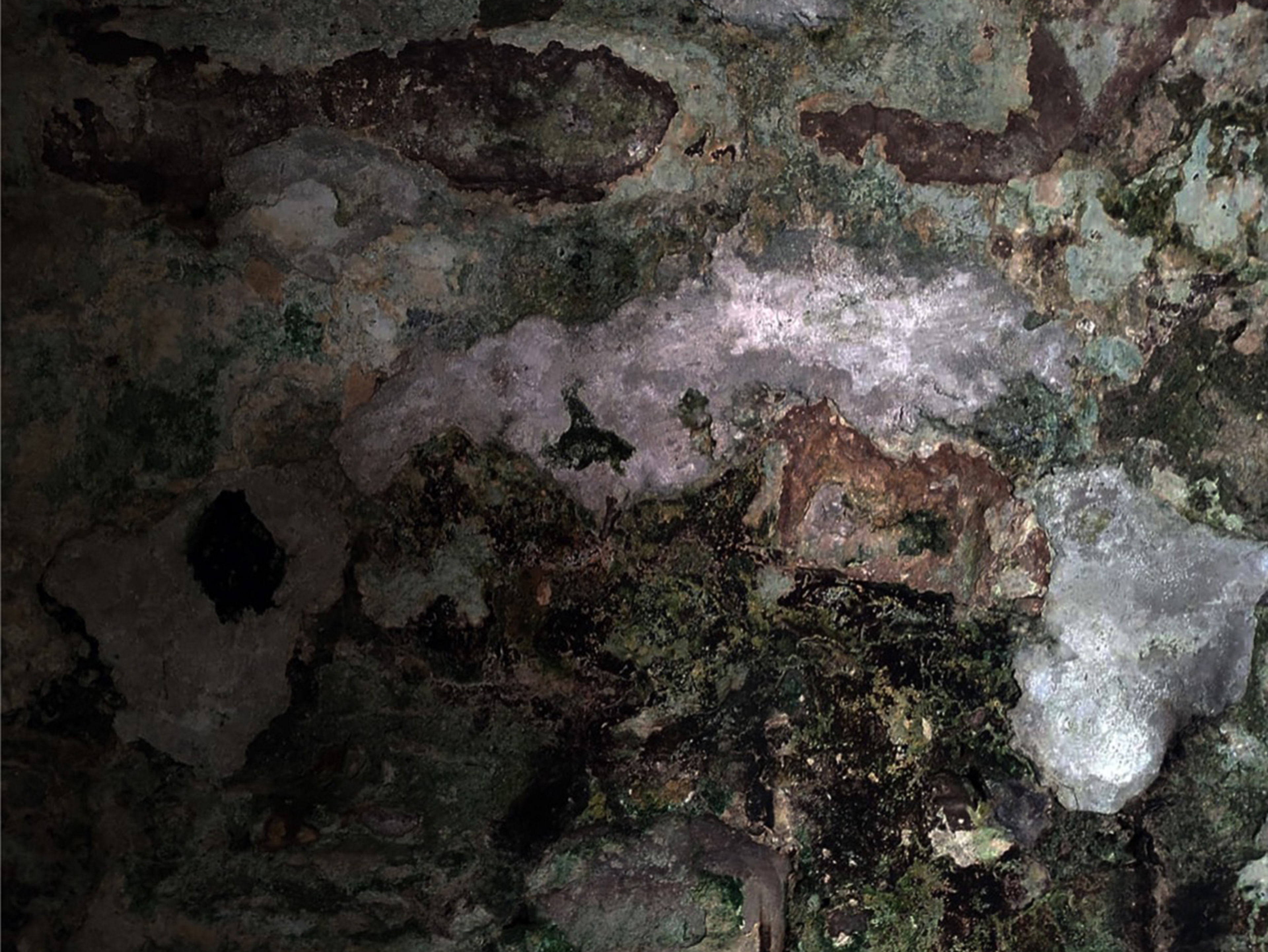
"Elmina dungeon's painful map", 2024 © Tom Correia
The light that should never fail us
1
Odo nyera fie kwan
Love lights its own path, never get lost when returning home
They say that from the first steps on Earth there is a metaphysical troop of angels that protect the crazy, the drunk and the children. In this list, I also include wanderers, especially the naive and distracted category. Those who get lost in the streets, those who go in the opposite direction to what they intended, those who choose the wrong route when they come across a fork in the road. They cross crossroads carrying a vague notion of danger that rarely scares them or stops them from continuing walking. Movement has always been my guide. Walking aimlessly in a place I've never been before has always served me as a perennial source of renewable energy. The longer the path, the greater the possibility of collecting insights.
I arrived in Accra three days in advance. In the first few hours, I was naturally drawn by a kind of irresistible impulse that takes us to the most well-known visiting spots in a city: I was impressed by the literary spices that I identified there, unusual elements that generate ideas and possibilities. Unlike the most famous similar market in Salvador, the Feira de São Joaquim, where my slightly addicted gaze seems tired of the same scene, in Makola I was forced to make several mental notes while fighting not to be noticed as a stranger. In vain. Feeling very uncomfortable about photographing, I tried telling myself. "Keep up the pace. It's only your first day." However, walking through the streets, I noticed, somewhat disappointed, that there was a rush at the end of the fair. Groups of men on the corners hissed and made the universal gesture that symbolizes money, offering to exchange dollars for cedis. Several groups of young people were resting in the shade. Maybe I was going the wrong way, managing the feat of not finding the busiest street in the most famous market in the Ghanaian capital. So, at a certain point, I slowly realized that there was a different hue to the daylight, which made me associate it with the proximity of the coast. For the first time, humbling my supposed sense of direction, I checked the GPS.
Jamestown is one of the oldest and most socially vulnerable neighborhoods in Accra. The signs are everywhere: on very simple houses, on the man carrying a huge bag of plastic bottles for recycling, on alternating stretches where sewage is exposed along the street. I asked several people for information until I arrived at the fishing village. I went downstairs and, when asking if there was beer, I was greeted by David, who called me to a higher part and offered me a plastic chair, with the back broken at the base. He told me that he liked welcoming people, showing that it was a safe place, different from what happened in Nigeria. He gave orders in Gã to the boys who seemed to work with him. My t-shirt with the photo of Pelé with his fist raised, hugging Jairzinho, opens our conversation about the greatest of them all and Messi. In Brazil, it would probably be the target of police raids under the pretext of imaginary search and seizure warrants, in that special Brazilian way of being prejudiced. It was also likely to become a backdrop for selfies from social media activists just hungry for engagement. I notice that three young people in a structure above us are shouting and laughing, looking in our direction. Obviously I didn't understand what they were saying, but there were only two alternatives: me or my host were the target of ridicule. I preferred not to ask what it was about. I just pretended I wasn't there.
[Dystopian Labadie at night. Bleating of a goat that often resembles the crying of a child. Or maybe a hybrid creature, a goat-child that could perhaps be used in the short novel I need to finish this year. African crows crossing the road on foot. The afternoon of heavy rain when there was no light. Ebo Taylor and Saidyia Hartman. Street vendors selling their products in a measured manner, in a dialect that is impossible to understand. The creaking doors' symphony. The sound of the wind through the smallest cracks in the windows.]
David asks a thin, slender boy, who looks about 14 years old, to accompany me to the beach. Before, I asked him why all the boats had foreign flags. From the United States to Spain; from Italy to Portugal; from the United Kingdom to the Netherlands. I couldn't locate the one in Brazil, which gave me some relief. David was unable to explain to me the origin of this representation. On the way, the boy speaks to me in Gã. I answer in English. No We understand absolutely nothing of what the other says, but we continue talking as naturally as possible. As if he were a tour guide, he points me to one end of the beach, where there was a discouraging amount of waste washed up by the sea. Still, the chaotic picture serves as a frame for an anti-postcard. A boy of about five years old waves at me and I wave back. His parents smile a little shyly.
I ask my guide what his name is. He says something back. Our communication boils down to hand gestures indicating the way back or whether photography was allowed there. When we were back to the point where I shared a Club Social with David, the boy became more talkative, although his face maintained an embarrassed expression, perhaps because he couldn't make me understand him. He didn't make any gesture similar to asking for money and I said goodbye to those closest to me, all of whom were very polite when responding. Despite attracting attention [after all, I was a black alien species with lighter skin dressed in black], at no point did I feel threatened or coerced. Once on the beach, what I noticed was another expectant look from the fishermen. Some waved, wanting to sell something. Others looked at me as if they were trying to guess what planet I had come from.
[I see the metallic gray viscera of an open sewer. I feel a certain fascination with an old sewing machine repair shop where there is a sign on the wall: "Don't urinate here". I don't understand the convoy of about a dozen hard-faced motorcyclists passing at high speed down a street in Makola. I stand still in front of an immense woman, with a tired expression and slow steps, selling fried fish in a bowl that she carries on her head. Osibisa and Kofi Awoonor. The man dressed all in white crossing a road on a bicycle carrying two children on the pillion]
2
Obi nka bi
Don't bite each other
Accra pulses even when the power is out. The electricity system is unstable in the country. At various times of the day or night, it is noticeable with some distress when the ceiling fan blades simply stop. However, the lack of this 'physical' light never bothered me. The privilege of living in the silence of a library presents us with other sources of energy and light. Those, yes. When they are missing, they leave us orphans. But the capital does not seem willing to be intimidated by the sequence of mini blackouts. The search for your own livelihood cannot stop.
I observe with special attention how life develops along the highways. The movement of street vendors under the Atomic Junction overpass is exuberant. The first few times I passed by there, I had to control the urge to ask the Bolt driver to pull over so I could get out right there, for the simple pleasure of observing. In Madina, on the banks of the N4 highway, vendors follow the intense rhythm of traffic. At four in the morning, the La Paz neighborhood is as busy as daylight. And on a national holiday, when you imagined the streets to be lifeless, what you saw was the usual intensity. The popular commerce with open doors, the tro-tro passing by packed, countless types of sweets and savory snacks, water, sobolo and soft drinks offered on a large scale, but without any truculence in the approach.
The look of the hundreds of street vendors is sharp. They track among the cars, the minimum visual contact with the potential to turn into a sale. At each stop at a red light along the highway, a parade of saleswomen begins who must walk kilometers throughout the day trying to reach their daily sales targets. With dignity and almost always accompanied by an aesthetic elegance in their clothing, however simple they may be, or in the way they arrange their products, arranged in such an artistic and meticulous way in basins, in wooden or metal boxes, that they easily seduces by the look. All you need to do is change some cedis and you'll want to try Accra's authentic street food. And wait until the next traffic light for the choreography to be repeated, dividing my attention between what is being sold and the expressive faces and looks of the saleswomen. Some gently smile back.
When we returned from the Nkyinkyim Museum, the traffic jam allowed us to observe the late afternoon illuminating the dozens of women street vendors who were waiting in line for the next round around the cars. Recording a scenario in which you live a survival diary [who knows how many kilometers are covered there, how much profit per day, each person's living conditions] can become a dilemma depending on the approach and intention. As a last resort, several mental polaroids were instantly stored. Let the word then take charge of keeping this memory.
Comparing other places to our original city is an arrogant way of feeling superior, a masochistic way of feeling smaller than you are. There is a great risk when comparing a city where we live and another where we are spending time. I can resist talking all the time about the chronic social problems of the place where I live to this day. However, walking through the streets of the Accra metropolitan area at night without having to look back the whole time was disconcerting. Even more so because it is not necessary to carry documents, something unthinkable in the place where I was born. Another aspect in which the silent comparison was inevitable, to a certain extent embarrassing for me. I saw pileups involving four vehicles, involuntary closures punished by a honk, a driver making a clumsy maneuver blocking traffic. In none of these cases did I witness exchange of insults, death threats or swearing. A driver is blocked by the vehicle in front, honks, swerves and life goes on. Neither looks at the other as an affront. If this is the chaotic traffic that people talk about so much about Accra, I'm sorry. There was a waste of a very poorly placed adjective.
Walking back from Jamestown, in one of its alleys I see a man washing a taxi. I ask if he will be free soon and he tells me that he is already available. I check with him the value of the race from that point to an imaginary place in my head. I just wanted to find a place to have lunch. We did a mini city tour. Our communication is a little truncated, despite being very friendly. We talk about the crisis of the Black Stars and the Brazilian team. The type of English that each person speaks creates difficulty in understanding each other. It is necessary to speak two or three times differently until one understands the other's message. Desmond took me to a Turkish restaurant that didn't sell beer or any type of alcoholic beverage, making me feel like an orphan. Before Desmond returned as we had agreed, I went out looking for a Salvador-style bar. I ask here and there. I arrive at a kind of grocery store with some customers on the balcony. I order a Club Social and one of them gets up and asks me to buy a dose of Luka, a cachaça whose smell only reminds me of Pitú [One of the most popular and strong-tasted Brazilian cachaça, made of sugar-cane]. It cost 2 cedis.
I meet Desmond again and, on the way back, I ask him to make a quick stop at a market. So far so good, he's always very helpful, but when he realized exactly where he was supposed to drop me off, practically on the opposite side of the city, with the traffic moving as if he'd ingested two huge plates of Fufu, he got a little upset. . He looked at his watch several times, swore, and didn't seem to understand when I said I didn't know anything about Accra. I even suggested that he drop me off somewhere on the highway and I would take another taxi. But he didn't accept it. It seemed to have become a matter of honor for him to finish the race.
At one point I said that going hand in hand with him would be a huge disadvantage, as he was a very strong guy. We laugh. Little by little, he stopped with the curses that he seems to have thrown out the window. When we finally arrived at Charis Home, I asked how much the ride was worth and he asked for a more than fair price, far from extortionate. Before turning around and leaving, he said I could call him whenever I needed.
[The food that inebriates us. Ebo with okro soup. The palm wine that leaves us light and laughing. The palm oil and pepper so familiar. Banku with Tilapia. Return to eating with your hands with the naturalness of a childhood that is long gone. Mpotompoto. The street food. Jollof with chicken. Spicy grilled octopus sold on the side of the road. The bread that can be eaten without butter. Boiled yam with palava sauce. Gastronomic abundance despite social asymmetries.]
3
Se wo were fi na wo sankofa a yenkyi
It's never too late to go back and pick up what's left behind
Every time I come across a gap in knowledge or information that I consider mandatory, I feel a kind of euphoria at the discovery and, at the same time, a kind of embarrassment that I try to disguise. I remember well when I listened with belated attention to Nina Simone's voice; and only last year was I able to watch "Watermelon man" by Melvin van Peebles. In these situations, I usually ask myself in silence what I was doing to the point of missing that book, film or historical fact that could make all the difference in my fragmented education. I answer myself: probably trying to live with minimal resources, maximum discretion and without putting my dignity on sale by carrying out paid tasks that are absolutely useless. But that no longer matters. However, after daily exercises between discoveries that are obvious to others and the self-demand to always be well informed, today, I consider that these gaps are like a driving force that keeps us alert and our curiosity intact. Anyone who no longer feels driven to new discoveries, is not open to new experiences, is technically a dead person inside. This is for those who have the opportunity to access it. For those in the middle of the street fighting for the days’ vacation, what's at stake is something else.
The first time I heard about Adinkras, for example, was way back in 2019, during a photo shoot. Even though I was aware of what I heard about African symbols, at the time I must not have been very receptive to alleviate my immense deficit of knowledge about the continent. I must have just found it "interesting".
Only now, after a significant amount of time, the fascination with the Adinkras took shape to the point where I planned a visit to Ntonso, a village on the outskirts of Kumasi, about 260km from the capital. But unfortunately there wasn't enough time for that. Accra is a jealous city. It involves and seduces us so as not to run the risk of being replaced by another in our affective memory. During every moment I was on the streets, I tried to be aware of the relationship between the population and all the beauty and meaning of these immemorial symbols.
But I saw little: in Adinkras Heights, a residential building on Liberation Road; the facade of a school in the downtown area; part of the external floor of the Zen Garden; Nyansapow's knot of wisdom in the LOATAD logo. Maybe the gap wasn't just mine. Perhaps this emptiness of structures is intentional, placing us apart from where we came from. Perhaps Adinkras were born for this very reason. Remain hidden to toast those who can find their way to them. As if it were the result of a personal and non-transferable search, for varied and inexplicable motivations. And from that, make the best use possible, learn to read between the lines, connect in particular with the unsaid that comes from time immemorial.
[Pan-Africanism. Deep sociopolitical discussions. Dubois. Economic context. Large capitalist conglomerates. Classic authors from several African countries still unpublished in my country. Ama Ata Aidoo. Documentaries. Books. Films. Nkrumah. Panel of illuminated versions of an unknown world. Twi phrases. Garvey. The desire to absorb as much as possible from an unprecedented ocean in which I find myself thrown and in which I am impelled to move with timid strokes. James Barnor and Cina Soul]
4
Nya akoma
Have heart, have patience
The intense back and forth that we walked through the galleries and outside the Circle Market revealed to me a particular skill of the Ghanaians. Amidst the traffic that competes for every inch with pedestrians, there are no bumps or collisions on the route. Even in the narrowest stretches, one gives way to the other, without being hit by any obstacles, in a natural flow that is equivalent to the sun and the heat that moves us.
We went up to the Makola Market Mall parking lot. From up there, it was possible to glimpse one of the region's classic images: a human anthill in full activity, a predictable metaphor, but one that makes sense. "Accra" originates from "Nkran", which means "ant" in the Akan language. Far from the comparison being a demerit, one of its most notable characteristics is precisely its work capacity. And if there is a place where work requires physical strength, mobility and communication skills to attract a client, it is popular markets the size of Makola. Amid the traffic that crosses the main street, people follow seemingly random trails, but everyone seems to know exactly what they are looking for, what needs to be done.
We had already seen three Kayayei girls sleeping on the stairs. The respective nearby basins. They must have been exhausted from the work they do as informal dockers. Those who are already adults carry disproportionate weight, transporting the goods that arrive in delivery trucks in a frenetic parade. They go up and down the streets without even having time to think about themselves. For those who arrive from the villages, it is a work alternative that requires "only" willingness and physical strength. They carry goods weighing 20 to 60 kg during the day and night, to earn around 20 to 50 cedis per day. Sometimes, they only earn "chop money", just enough for their daily food. Many work with their children strapped to their backs.
It is estimated that there are around 100,000 Kayayei in the country. Many are still children. And one of them came towards me in the parking lot, holding an aluminum basin. Her face had beautiful skin, but her expression was tired. She mumbled a sentence and pointed to a vacant spot in the market below. Unable to understand, I ask what she wanted. She doesn't react. She points to the same place again. Soon after, she walks away and I don't see her anymore. The way she was dressed, in that light, with all that weight on the face of a girl of about 10 years old, she was a ready-made photograph. In a few clicks, excellent portraits are likely to emerge. But I didn't even consider it. Although every street photographer is a kind of thief of other people's images, there is a limit to common sense and feeling. Exploiting vulnerable children, even under the pretext of documenting them, is a delicate and complex issue.
In fact, in terms of photography, in addition to having sought to shield myself from the temptation of falling into clichés, I consider that Accra put me in my right place, making me understand that it takes much more time to circulate, to make my presence commonplace to the point of making me invisible. Time to create minimal bonds with the people who allow themselves to be photographed, to explain to them that my interest is not commercial, but documentary. Maybe time for them to leaf through a book of photographs I published about black people on the streets of Lisbon. Time to understand the street code, to learn how to read the surrounding scenery more accurately. Maybe all of this is also a secret password to return. Having the opportunity to return that millions of enslaved people did not have when they were forced to pass through Cape Coast.
Perhaps the best photos I took were the mental ones. This may have saved me from the horrendous clichés, the repetitive and boring whirlwind of millions of images that oppress and anesthetize us. No matter how attractive the scenes are, I refuse to photograph inside a vehicle. I would feel like a tourist with a stupid smile who was proud to be going on safari. Or I walk the streets, interact with people, make mistakes due to my particular difficulty in understanding what people say to me [no matter in which language]. Maybe there is even some ICD for this.
[This night I dreamed about my dear friend Janaína. She looked beautiful and smiling as always, her face glowed and she was dressed as if she was playing a role in a movie musical. She and a friend were on a luxury cruise ship, but I couldn't see the other woman's face. They entered a hall in small dance steps. Janaína was very happy, laughing, celebrating the moment in a beautiful shiny dress that exposed some parts of her body. She was in very good shape. At a certain point, I realized that I was actually watching a film, perhaps about her life, sitting in an empty movie theater. There was only one guy in his 30s, but I could not see his face either. I mentioned to him that Janaína's facial expression was about to change as soon as she came out of the deep dive she took in the ship's round, blue pool. That's what happened. The camera zoomed in on her face, now with a very serious look. Suddenly, there was a rush on the ship, but I can't say whether it was some confusion or a lively carnival dance.]
Janaína suffered a cardiac arrest on December 31, 2012, while sitting and smiling with friends in Mallorca, Spain. She has been in a coma for six months and passed away on August 30, 2013. She was just 36 years old. This dream maybe represents an obvious interpretation: life might be so short, it doesn't matter how much life you feel inside; life is so short, it doesn't matter how much light you have inner side.
5
Nyame biribi wo serum na ma mensa nka
God, there's something in the sky, let me reach it
She had no idea it would be so fascinating to receive the results of an ancestry test. Discovering that I have 51% African descent, of which 26% indicate Costa da Mina [Benin, Ghana, Nigeria and Togo], is to shine a light on a past that was more of a natural identification than actually proof. The symbolism of making this discovery on African lands, especially on Ghanaian soil, is at the same time joy and a moment of silence, pride in origins and retroactive melancholy of centuries. I feel thrown back to the castles of Elmina and Cape Coast to imagine the darkness of their dungeons, to contemplate the last moments of agony of those who have passed away. Or I find myself back to walk once again barefoot and in silence on the Ancestral Slave River in Assin Manso. And wet your feet, hands and face, simulating the last of the baths before the last march to exile or death from ill-treatment.
The city lights seen from the top of the buildings. The energy that was missing in the early hours of the morning. The light that took centuries to eradicate the darkness surrounding the markets for enslaved people. The damn darkness in the solitary confines of Elmina Castle. The light that was missing in the eyes of a thin woman, standing on one of the corners of a village on the way to Cape Coast, an expressive and indecipherable look that followed mine until they lost each other.
Only now has it been possible to fully understand what Africa has always meant to me: the light that I was missing. All the light of a continent, a country, a city waiting for me. Something like the brilliance of the Accra Girls, talented high school girls, as they recited their own poems. Or even in the sincere smile of a street vendor who sold books at a traffic light in the Osu region.
So, all I can do is say: medaase*, Ghana, medaase.
And I really wish to be very happy with you again someday. Very soon.
[A more than special medaase to my dear fellow residents who emitted a radiant light every day: To Kirstie's unmistakable laugh. To Vida’s culinary talent. To Crystal's generous gestures. To Alberta's diligence and seriousness. To the lightness of Kim's soul. To Jeff's vibrant presence. To the enlightened omnipresence of Seth. To Sylvia's sensitivity and elegance.]
*"Thank you" in Twi, a variety of the Akan languages spoken in Central Ghana.